Here's one I can't reason my way around.
Imagine two people applying for the same remote technical position.
One manages chronic pain with physician-supervised opioids while the other manages a neurological disease with state-authorized medical cannabis.
Both are using controlled substances as part of legitimate medical treatment, submit to the same pre-employment drug screen.
One positive result quietly disappears before the employer ever sees it.
The other follows the candidate all the way to HR.
Why?
Most people assume the answer is safety. I'm here to tell you, it isn't. Here's what actually happens.
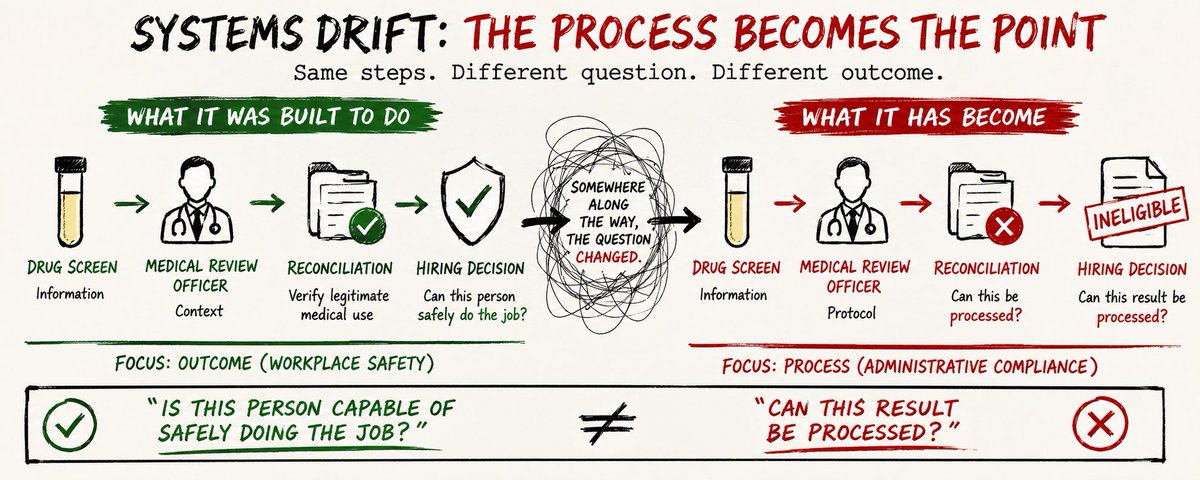
Candidate A tests positive for opioids > The laboratory forwards the result to a Medical Review Officer, who verifies a legitimate prescription > The employer is notified the result is negative.
Not "positive, but explained." Negative.
The positive result is administratively reconciled and disappears from the hiring decision.
Candidate B tests positive for cannabis > The End. There is no equivalent administrative pathway.
The medical condition can be legitimate, as can the physician oversight. The candidate may be applying for a fully remote technical position where they never set foot on a production floor but the outcome remains unchanged. The paperwork and the hiring process reach a dead end.
Here's the question I keep coming back to; if this process exists to identify workplace risk then why doesn't it actually evaluate workplace risk?
It doesn't compare impairment, dependence or overdose risk. It doesn't compare whether either person can safely perform the job they're applying for.
It compares paperwork.
One controlled substance has an administrative mechanism that converts a positive into a negative while the other doesn't. That's not the same thing as measuring safety.
At this point, someone usually says, "Well, one is prescribed."
No.
Both people are under the care of licensed physicians and using controlled medications as part of legitimate medical treatment.
The difference is that one treatment has a federally recognized administrative pathway that allows a positive drug test to be erased before it reaches the employer and the other doesn't.
The hiring system isn't distinguishing between more dangerous and less dangerous or more impaired and less impaired.
It's distinguishing between what federal paperwork knows how to process and what it doesn't. That's an administrative distinction, not a safety assessment. We've confused compliance with competence.
One treatment carries a well-documented risk of dependence, abuse, respiratory depression, and fatal overdose. The other has a markedly different safety profile in those respects. But the hiring process doesn't compare those risks. It compares whether one medical treatment fits neatly inside an existing federal administrative workflow.
If it does, the positive disappears.
If it doesn't, the candidate disappears.
This is the part that scratches on my brain like sandpaper on a silk pillowcase.
Every step in the process is internally consistent and all the boxes get checked. The policies get followed and the audits come back clean.
But somewhere between the first drug screen and the final hiring decision, the original question disappears. The process no longer asks, "Is this person capable of safely doing the job?" Instead, it asks, "Can this result be processed?"
I write all the time about systems drift; when success is defined by compliance with a process rather than by the outcome the process was built to achieve.
Quality systems, hiring systems, AI systems, governance systems all drift.
This feels like another example.
We're told the process exists to improve workplace safety, but from where I'm sitting, it appears to optimize for something else entirely.
Defensibility.
An organization can demonstrate perfect compliance with federal policy but whether that process consistently identifies the safest, most capable, most competent employee is an increasingly different question. I wonder if we've stopped asking it.
FIELD NOTE · FN-05 · EVIDENTIARY BURDEN