I was scrolling, doing what I always do. I was waiting to find a thread to pull. I love when one finds me!
That’s when I came across something Gene Simmons said on a red carpet. He was asked about his political views by a reporter and replied:
“When I was first starting to vote, there used to be a curtain and you voted anonymously and you voted your conscience. And nowadays people wanna know who you're voting for. What the fuck business is it of anybody?”
Well. There’s the thread.
Because I knew exactly what he meant. Voting used to feel like something you did privately, behind fabric, alone with your conscience. You walked into the booth, made your decision, walked back out, and nobody was entitled to know your choices. But that wasn’t actually the thing that caught me.
The thing that caught me was how completely normal the reporter’s question felt.
Nobody watching that interaction was likely confused about why a celebrity was being asked about politics; we do it all the time. We ask actors, musicians, athletes, CEOs, authors, people promoting movies, albums, shoes, soda, themselves. Somewhere along the way, asking another person to publicly locate themselves politically became almost casual and refusing to answer became suspect. That was my first speed bump.
When did political preference stop being something you could keep private and become something other people felt perfectly comfortable asking you to disclose?
Then the question got bigger, because we don’t just want the answer anymore. We want to do things with it.
Tell me who you voted for and I may think I know what news you watch, which institutions you trust, which causes you support, which behavior you’ll excuse, what scares you, what pisses you off, maybe even what kind of person you are.
That’s an enormous amount of information to think we can extract from one answer.
So now I had two questions sitting on top of each other: when did asking become so normal, and when did the answer become so useful as a proxy for everything else?
I didn’t know, so I started pulling.
My mind went to 2016 first. Not because I’d proven that was the beginning, I hadn’t proven anything, it was simply where I felt what I describe as friction. What I mean by friction is that I often notice a mismatch before I can articulate what the mismatch is, something in the pattern feels off before I have the evidence or language to explain why, and that feeling is usually what tells me where to start digging.
In 2016, Donald Trump openly challenged media legitimacy; the media challenged his in return. Two things happening at once, and the second I tried to decide which one mattered more, I realized I was already asking the wrong question. I wasn’t interested in deciding who started it or who was more at fault. I wanted to know what had changed in the system that made both sides so ready to question the legitimacy of the other, rather than simply disagree within a framework they both still accepted. It was as if the referee had stepped into the ring, or at minimum a lot of people had begun arguing about whether the referee was still outside of it. That distinction matters. I don’t have to prove the referee was biased to observe that people were fighting over whether they were. Those are different claims, and once I separated them, 2016 got more interesting because it stopped looking like a simple political fight and started looking like evidence of a deeper legitimacy problem.
At first I thought I’d found my answer but if 2016 was exposing a legitimacy problem rather than creating one, then I still hadn’t reached the bottom.
If trust had been solid going into that moment, why did the accusation of bias have so much power? You can yell “the referee is crooked” all day long, but it only changes the game if enough people are already willing to entertain the possibility of it. That doesn’t tell me whether they were right, but it tells me the accusation found something to stick to.
That was another speed bump, so I changed the question again.
Not what did 2016 do? but What was already there for 2016 to activate?
So I went backwards and that’s how I ended up staring at 2008.
The bailouts.
And no, I didn’t suddenly decide the financial crisis and the media fight of 2016 were secretly the same thing. They’re not. Different systems, different failures, different actors, different consequences. I got there because I hit friction again. That little mental hitch of: Wait. Why does the system behave like that?
Risk had accumulated at enormous scale. Institutions were in trouble. The consequences threatened to spread well beyond the people and organizations that had taken the risk, so the system moved to stabilize parts of itself. Meanwhile, ordinary people were losing homes, jobs, savings and security.
There are economic arguments for why those interventions happened. Good ones, bad ones, complicated ones. I don’t need to resolve them to notice what interested me, and pretending I did would be exactly the kind of assumption I’m trying not to make. The thing I was examining wasn’t whether the bailouts were correct. It was the perception created when institutions and individuals appeared to experience failure differently.
Risk at one level could become a systemic problem requiring intervention, while at another level the consequences remained intensely personal. That was the friction. Not that the two situations were the same, but that the system could treat failure very differently depending on where it occurred.
And that gave me a better question: what happens to trust when people start noticing those differences, especially if they don’t understand, accept, or even know the reasons behind them?
That question felt more honest than jumping straight to “the rules are unfair,” because I didn’t know that yet. Maybe the rules were working exactly as designed. Maybe the difference was necessary. Maybe people misunderstood what the institutions were supposed to do in the first place. All of those possibilities stayed on the table, but perception matters in a trust system, even when it may be incomplete.
People don’t experience institutions as flowcharts. We experience outcomes. We notice exceptions. We notice who gets grace or discretion and who gets consequences. We remember the places where what happened didn’t match what we expected to happen and then we carry those memories forward.
That was the connection I had actually been looking for. Not sameness; accumulation.
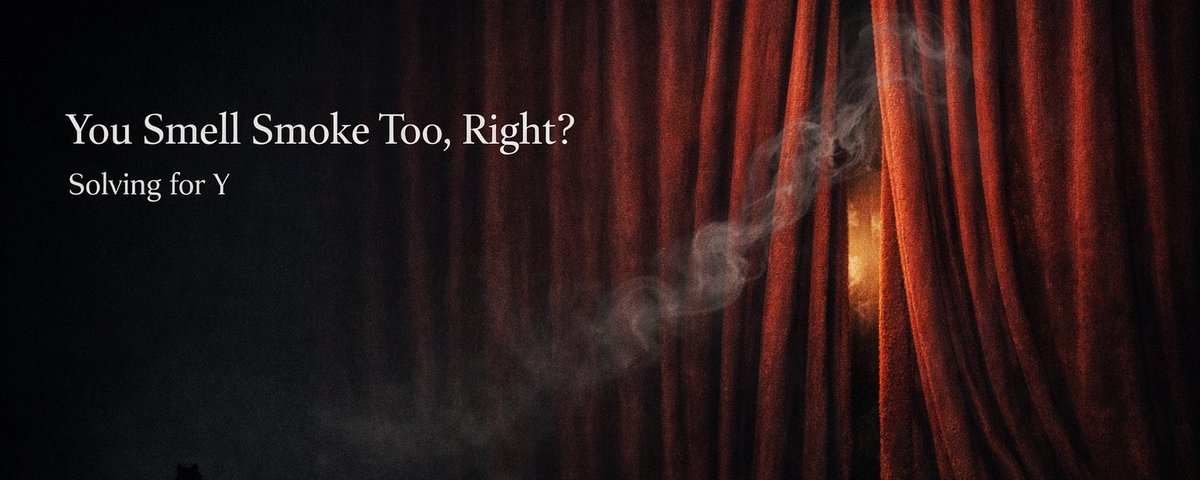
One event doesn’t have to cause the next one to alter the conditions into which the next one arrives. That distinction changed the whole thing for me. Trust could thin without disappearing. An institution could still function while more people started questioning how it functioned. A person could accept one explanation and still file away the discomfort. The curtain doesn’t have to burst into flames, it can just get thinner, thread by thread.
Now 2016 made more sense to me, but not as an origin story. It looked more like a pressure test.
A legitimacy argument landed in a system where questions about institutions, fairness, expertise and authority were already circulating. Suddenly, people weren’t only arguing over candidates and policy. They were arguing over who could be trusted to describe what was happening at all. That’s completely different. Once people start disagreeing about the referees, knowing where another person stands becomes more useful, not because their position tells you who’s right, but because it starts to tell you who they’re likely to see as us and who they’re likely to see as them.
That matters way more in a polarized system, especially when disagreement stops feeling like “we want different policies” and starts feeling like “the other side is dangerous, dishonest, immoral, or threatening something fundamental.” By 2016, substantial shares of both Republicans and Democrats were already describing the opposing party in exactly those kinds of terms, not just as wrong, but as a threat to the country’s well-being.
Once politics starts carrying that kind of moral and emotional weight, knowing where someone stands does more than place them on an ideological spectrum. It helps you decide whether someone is likely to be an ally or an opponent, trustworthy or suspect, not because their position proves anything about who’s right, but because it tells you where they seem to stand in the larger conflict. And that got me back to Gene Simmons.
Why do I care how he votes? Personally, I don’t. But if political alignment has become a shortcut for locating people inside a much larger legitimacy fight, then asking starts to make a kind of systems-level sense. Tell me your vote and I think I know your heart.
Which institutions do you trust? Which ones make you suspicious? Which stories sound plausible to you before you’ve even looked at the evidence? How much evidence do you look at when you trust the source? Which people get the benefit of the doubt? Which people don’t?
Of course, that proxy is sloppy as hell, people aren’t that neat.
A Republican can distrust Republicans. A Democrat can distrust Democrats. Someone can agree with a candidate on one issue and think they’re an idiot on five others. People are inconsistent because human beings aren’t spreadsheets. But proxies aren’t useful because they’re necessarily accurate, they’re useful because they’re efficient. Political identity became a proxy for our humanity, a shortcut for everything we think we need to know about another person before we’ve actually learned much about them at all.
Now I had a different problem. Was that development organic?
Social media rewarded visibility, algorithms rewarded engagement, and outrage produced engagement beautifully. People increasingly lived parts of their lives in public, so political identity became one more thing to display, discuss, fight over and perform. But that explanation wasn’t sufficient in and of itself, because anything that reliably moves people eventually becomes useful to people who want to move them.
Political actors, media, companies, activists, even audiences themselves can exploit identity by rewarding the people who perform the right signals and punishing the people who don’t.
So was it organic or strategic? At first that looked like a fork in the road, but the cleaner I tried to make the distinction, the less it held. The two paths weren’t mutually exclusive, they were feeding each other.
Organic behavior created opportunities for exploitation, exploitation changed incentives, those incentives altered the organic behavior, and that altered behavior created new opportunities for manipulation. Then people began reacting to the manipulation itself, adding another layer to the system. So the fork was real, it just didn’t stay a fork for long. The paths kept folding back into each other until cause and response became difficult to separate.
Nobody had to sit in a room and design the whole machine for that to happen. Everyone only had to respond, more or less rationally, to the incentives directly in front of them, and eventually the system could begin producing outcomes that no single participant had actually intended.
Which brought me back to the red carpet, except now the interaction looked different.
The reporter asking Gene Simmons about politics no longer felt like a random cultural habit. It looked like the downstream effect of everything I’d been tracing: political identity had become useful shorthand, useful shorthand had become socially normal, and once that happened, asking for the signal stopped feeling intrusive.
That was the part I hadn’t been able to see at the beginning. The question on the red carpet wasn’t the mystery anymore. It was the symptom. The next thing worth interrogating was what happened when someone refused to cooperate with the sorting. That might be the strangest evolution of all.
Silence used to mean we didn’t know. Now silence can become something to interpret.
Why won’t he answer? What’s he hiding? Is he afraid of alienating people? Does his refusal itself tell us which side he’s on?
We can turn no data into data if we try hard enough and that’s where I finally understood why his answer caught me. It wasn’t really about the voting booth. It was about the expectation represented by the curtain. The curtain said you were allowed to participate without performing your participation. You could have a political conscience without making your conscience available for inspection. You didn’t have to convert a private judgment into public identity but somewhere along the way, that expectation changed. Not universally, not all at once, not because one villain flipped a switch. That’s too tidy, and the system doesn’t look tidy to me.
It looks recursive.
Institutional trust shifts. Political alignment becomes more informative. Alignment becomes a proxy. Proxies make sorting easier. Social systems reward visible signals. Visible signals make asking for them feel normal. Asking becomes normal enough that refusing becomes conspicuous. Then the refusal itself becomes another signal to sort and suddenly a reporter asking a musician how he votes barely registers as unusual.
Until the musician says, essentially:
Why the fuck do you need to know?
And for half a second, the whole thing becomes strange again.
That’s the moment I’m interested in, because he created friction. He made something familiar feel unfamiliar long enough for me to notice it. I feel the speed bump, so I interrogate it. Sometimes the first answer feels satisfying for about five minutes before I realize I’ve only explained the surface, so I keep digging. I follow whatever survives the next question and discard whatever doesn’t. Sometimes I end up somewhere I didn’t expect.
2008 didn’t prove 2016.
2016 didn’t explain Gene Simmons.
Gene Simmons didn’t explain political identity.
That isn’t how the thread worked.
Each knot in the thread changed the question and every time the question changed, the system came into slightly better focus. That’s the part I care about: not proving that my first instinct was right, but finding out whether it survives contact with the next piece of information.
The moment you see the curtain thinning, you can’t go back to believing it’s opaque. What changed was that I started noticing how much I had assumed about what was on the other side of it, assumptions I’d never had a reason to question until I could finally see through.
Maybe that’s the real point of the thread. Privacy, neutrality, trust, legitimacy, none of them disappear all at once. Sometimes they just become visible enough that you start questioning what you had previously taken for granted.
And seeing through the curtain doesn’t mean you suddenly know what’s behind it. That distinction matters. Feeling the pattern is what tells me where to look, not what I’m allowed to conclude.
So the question isn’t who tore down the curtain. It’s whether we ever mistook not being able to see through it for proof that nothing was happening behind it.
Once you see the threads, you start counting them, not because every thread proves your theory, but because every one gives you another chance to test it, challenge it, and try to break it.
FIELD NOTE · FN-01 · SOLVING FOR Y